How to make more 10 pins
The 10 pin (or 7 pin for lefties) is the thorn in the side of most bowlers (including the author). It's often the most common single pin leave, since you can throw a good shot and leave it with the wrong pin action for a variety of reasons. Maybe your ball rolled out and lost too much energy, or maybe it hit the pocket with too much or not enough angle. Left handers will have the same problem with the 7. The fix is the same for both: establish a spare system, practice, measure your results and practice more.
Why you keep missing the 10 pin
There are some common reasons why bowlers struggle with the 10 pin.
You vary your routine. You might do one of the following:
- stand on a different board
- use a different target,
- vary your drift from starting board to sliding board
- throw the ball a different speed or style (flat, backup, hook)
- use different balls for the spare
If you don't maximize your consistency, it's hard to establish your baseline to improve from.
You throw your strike ball at it. A reactive ball is going to behave differently in different conditions versus a plastic ball. Unless you can completely flatten it out, it introduces some unpredictability.
You are aiming at the pin. This may work for some people, but having a board or arrow target might teach you more about how you are missing your mark.
Three fixes to improve your 10 pin conversion rate
Throw it straighter. A plastic spare ball is the single best purchase a league bowler can make after a strike ball. If you do not have one, take the hook out of your release: firmer wrist, less hand at the bottom of the swing, a bit more speed. A straight ball at the corner pin needs to hit within a few inches of its center. A hooking ball needs to hit a moving target.
Use a spare system. Pick a spare system, learn the numbers for the 10 pin, and use them every time. Make small adjustments when you see a pattern in your misses. This might mean moving a little left, right, up or down on the approach. The three systems below all handle the 10 pin well.
Cross the lane. Stand on the left side of the approach and roll the ball through the middle toward the right corner. The angle gives you more margin for error: a ball a little left still catches the pin, a ball a little right still catches it. Typically, the less you go across the lane, the less your margin for error is.
Three spare systems to consider
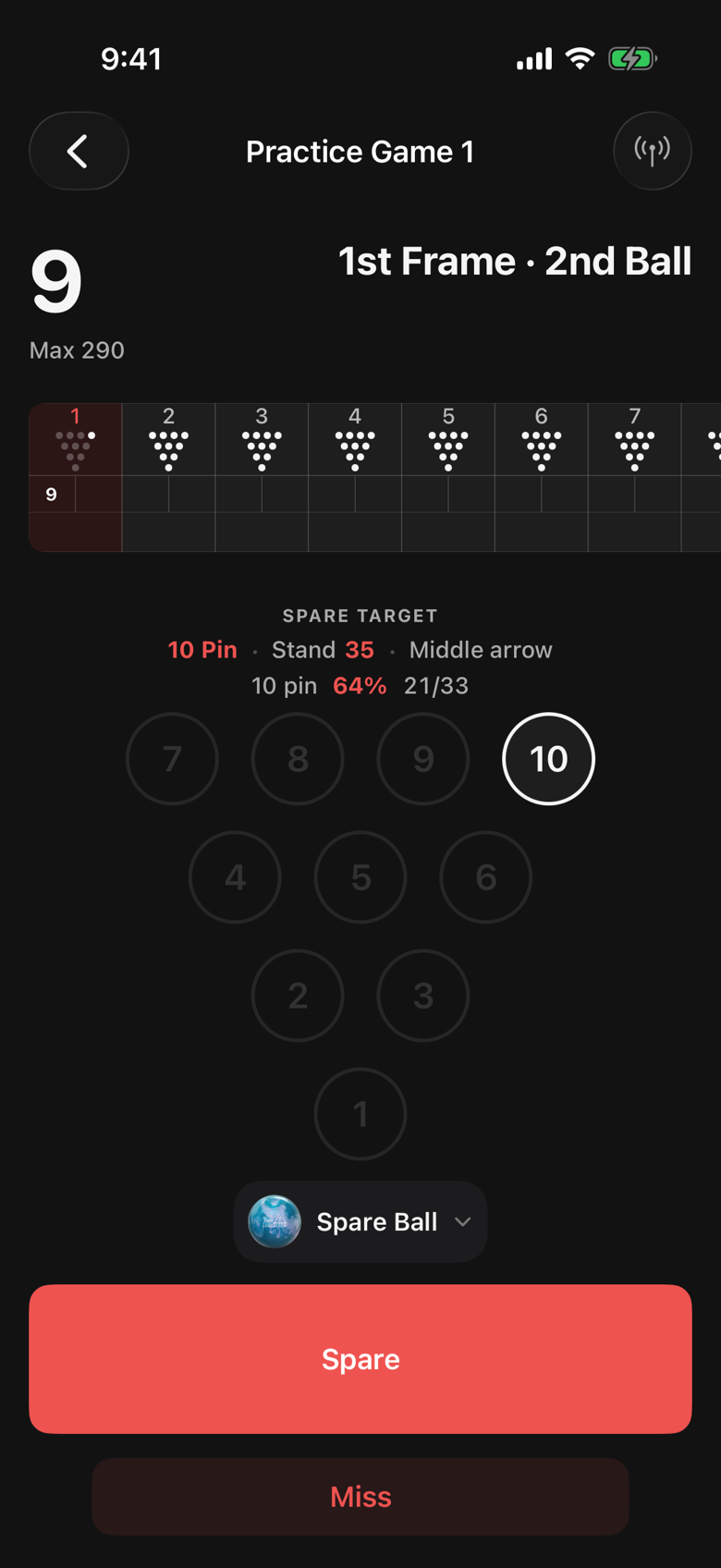
Middle Arrow keeps the target fixed. Every spare goes over the fourth arrow, board 20. For the 10 pin a right hander stands on board 35 and rolls at the middle arrow. It is the simplest system to start with and works well for most bowlers.
3-6-9 keeps your strike target fixed and moves your feet. For the 10 pin, move nine boards left of your strike stance and throw your normal shot at your normal arrow. It suits bowlers who want their spare shot to feel like more like their strike shot.
Triax keeps your feet on an anchor board and throws straight at one of two marks. For the 10 pin a right hander stands on board 35 and throws straight at a right side mark near board 18. It is the most precise once your marks are found, and it needs a straight ball to be effective.
For all systems, left handers mirror everything. If you are using Advanced Bowling Tracker, the app will provide guidance and reminders for you.
Establish a practice routine
If you are practicing, first get warmed up with however many shots you need. If you are using Advanced Bowling Tracker, you can use the drill mode, but if not you could do the same with a notepad.
- Pick your system and your targets.
- Set up on the approach with your shoulders aimed at your target. Look at your target arrow.
- Throw at least ten shots and count makes and misses. Try to be strict on yourself if aiming at a full rack.
- If the misses tend to one side or the other, move your feet one board toward the miss and throw ten more.
- Note the board where you had the most success.
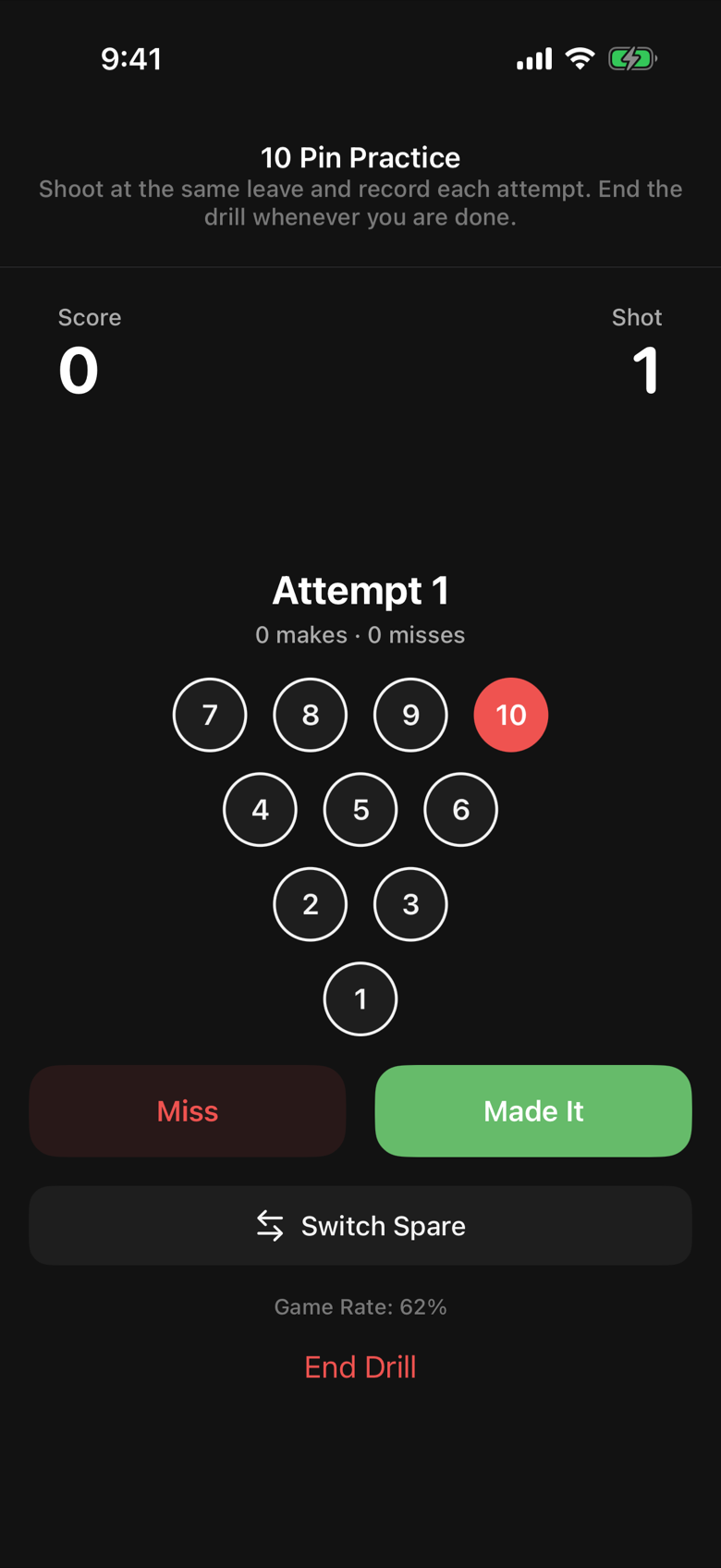
Advanced Bowling Tracker has a drill built for this. Under New Session pick Drills, then Spare Practice, then the 10 pin from the Single Pins preset. The app counts attempts, makes and misses, shows your current conversion rate for that leave, and saves the drill so you can see whether the routine is working from week to week.
Track over time
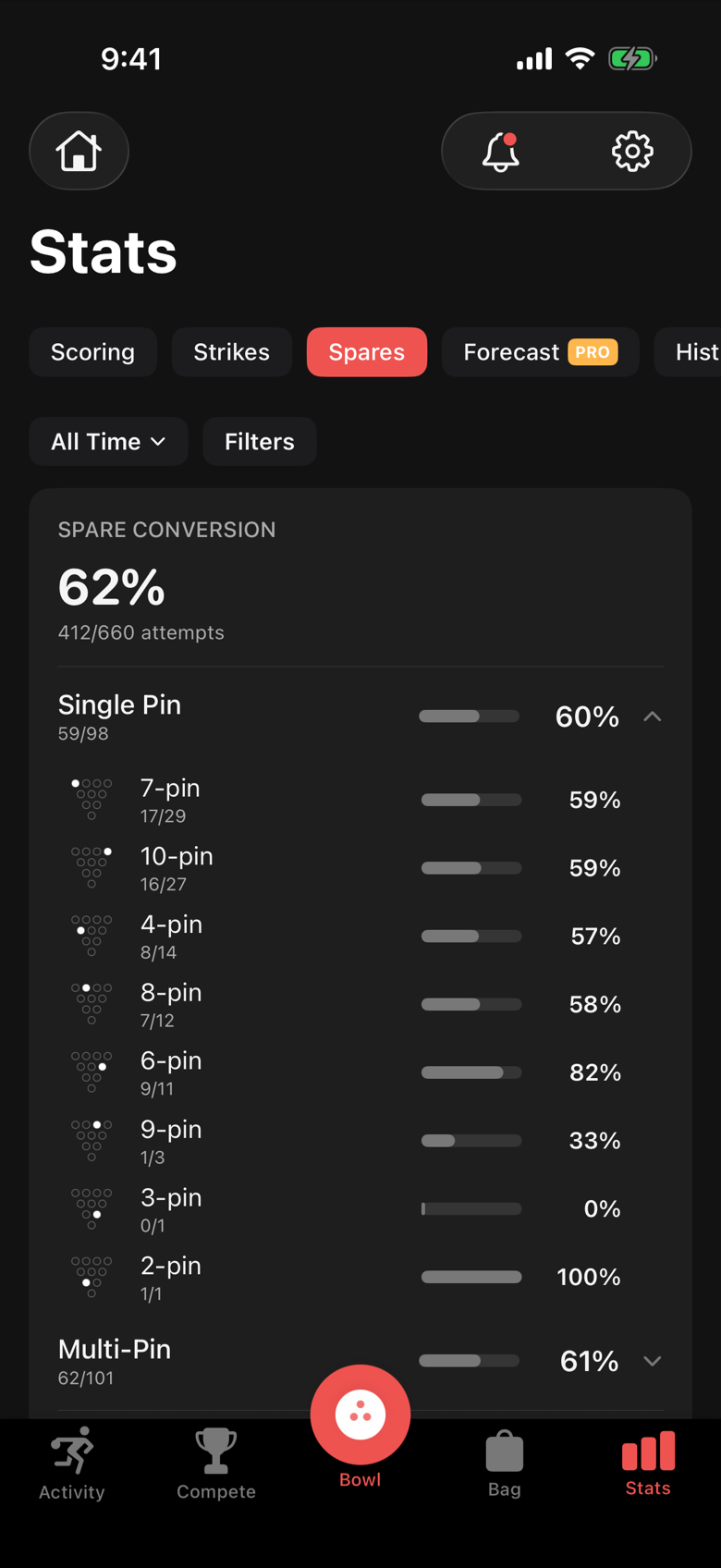
Watch your 10 pin conversion rate over time and see how your performance changes. Open the Stats tab and tap Spares. The single pin section lists every pin with your makes and attempts, and a Most Missed card at the bottom tells you which leave is costing you the most.
During a game, after a first ball that leaves the 10, the scoring screen also shows your conversion rate ("10 pin · 52% · 22/42"), and if you have a spare system turned on, the Spare Target line above it tells you where to stand and what to throw at.
A 10 pin conversion above 80 percent is generally a great benchmark to aim for. Below 60 percent and the 10 pin alone is likely costing you five to ten pins a game.
FAQ
Do I need a plastic ball?
You need a ball that can go straight. Plastic is the cheapest way to get one and it ignores the lane condition. A urethane ball can also go quite straight if you can cut down on your rotation. If you throw one ball, learn to flatten your release for spares and give yourself a few practice sessions before you judge it.
Why do I keep missing the 10 pin to the right?
Most of the time the ball is hooking less than you expect, or you are pulling the shot because you are looking at the pin. Check your target first. If the target is right, move your feet one board right (toward the pin) and keep the target.
And to the left?
The opposite. The ball is hooking more than you expect, or you are opening your shoulders and swinging across your body. Move one board left, or take more hand out of the release.
How many attempts before the stat means something?
At least 20 attempts gives you a good sample of your 10 pin conversion rate. The app's in-game hint waits for five attempts before it shows a rate, and the Most Missed card ranks by attempts as well as misses, so one bad night does not send you chasing a fix you do not need.