How to improve your bowling average
It sounds obvious, but the more frames you close (spares and strikes) the higher your average gets. Your average goes up when you stop leaving pins on the lane, and typically most of the pins you leave on the lane are from missed spares.
This guide is a plan built around the numbers: find your particular weaknesses, focus on improving them, re-evaluate and keep working.
Where the pins actually go
Take a 150 average bowler. Over ten frames they might throw three strikes, convert four spares, and leave three open frames. Each open frame costs roughly ten pins versus a spare, if not more.
Turn one open frame a game into a spare and your average climbs about ten pins. Turn two and it is twenty. That is a 150 becoming a 170 without a single extra strike.
For a 190 bowler the arithmetic may shift. Spares conversion typically rises, and the pins hide in carry: pocket hits that leave a 10 pin, a 4 pin, a 7. That is a ball and angle question as much as a release question. And above 200 it may come down to strike percentage and the 10th frame performance.
So the first job is finding out which bowler you are. That needs a record of every frame, which is what the score tracking guide covers.
Start gathering data
- Measure. Record every frame for at least three league nights, including which pins stayed up on the first ball and which ball you threw.
- Find the leak. Look at spare conversion first, then first ball average and pocket hits, then strike percentage. The weakest of those is where the pins are.
- Practice your weaknesses. If your 10 pin conversion is low, instead of just bowling practice with no intention, take time to focus just on converting the 10 pin.
- Learn your equipment. If your first ball is hitting the pocket and leaving corner pins, you might have the wrong ball for the conditions. See the arsenal guide.
- Keep measuring and reevaluate. If you aren't improving against your weaknesses, keep practicing them.
Many bowlers plateau because they skip steps.
What to measure
Advanced Bowling Tracker's Stats tab is organized around these questions. The five tabs are Scoring, Strikes, Spares, Forecast and History, and each one can be filtered by time window, by format, by center, and by session type, so you can look at league only, or one house, or the last month.
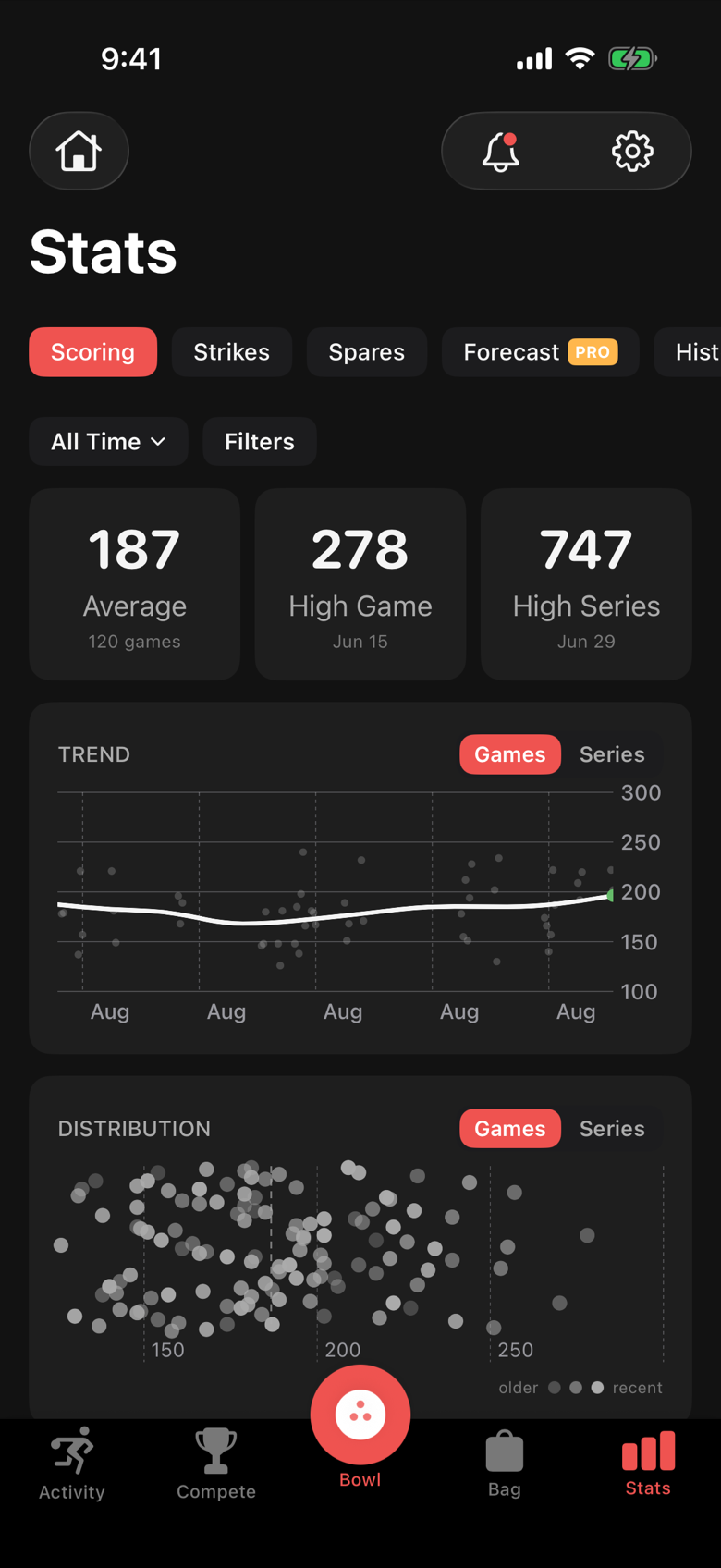
Scoring gives you the headline: Average, High Game, High Series, the trend over time, a distribution of your games, and a 10th frame card comparing your 10th frame pinfall and strike rate with the rest of the game. The By Ball and By Location breakdowns are where the surprises live. Bowlers regularly find they average ten pins more with the ball they think of as their backup.
Strikes shows strike rate, your rate after a strike versus after an open (the "can I double" number), and your longest string.
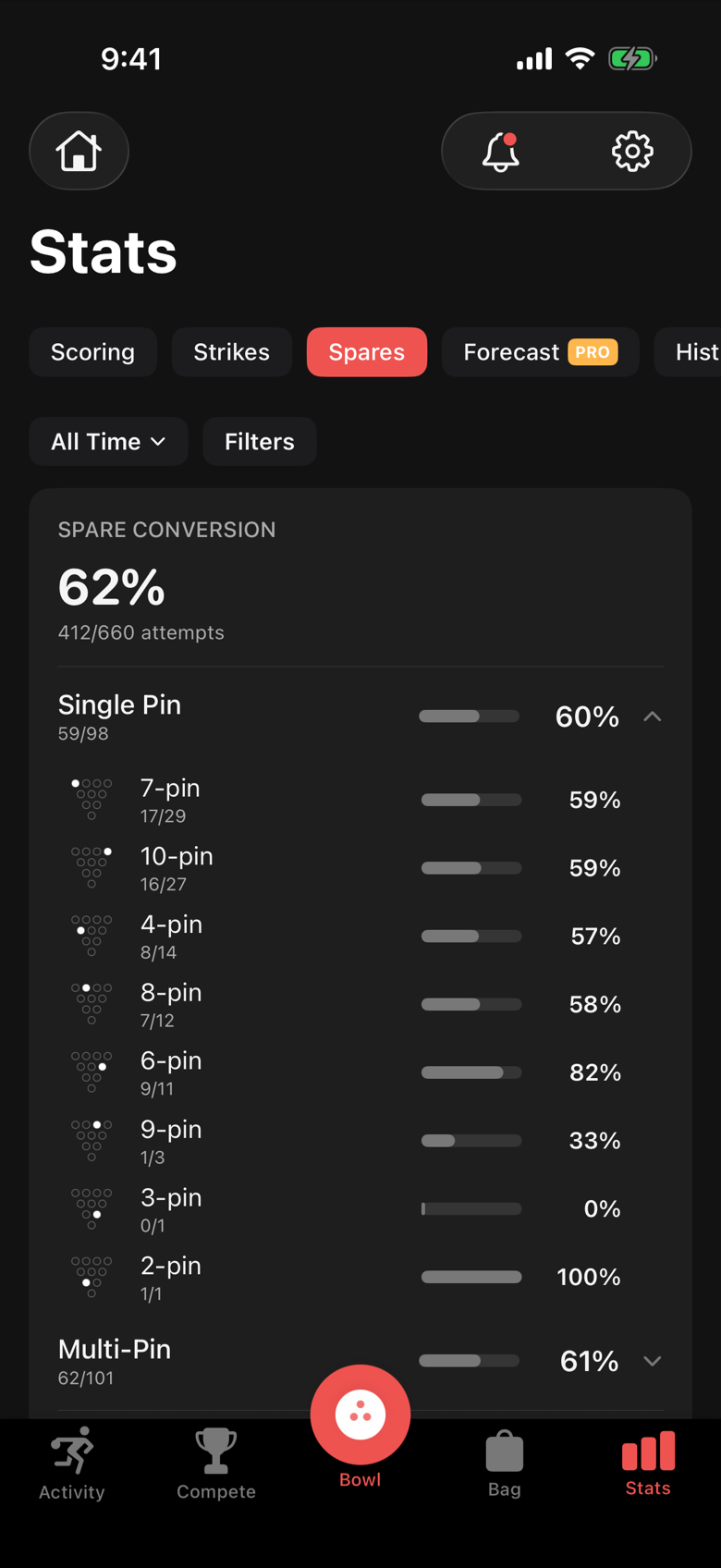
Spares is the tab that pays. Overall conversion at the top, then four categories to drill down: Single Pin, Multi Pin, Splits and Unmakeable. Under those, a Most Missed card ranks the leaves that cost you the most, weighting attempts as well as misses so one bad night does not top the list. Whatever sits at the top of Most Missed is a great candidate to focus on improving.
Practice with a purpose
Practice with purpose is the best way to improve. Here are some formats to consider:
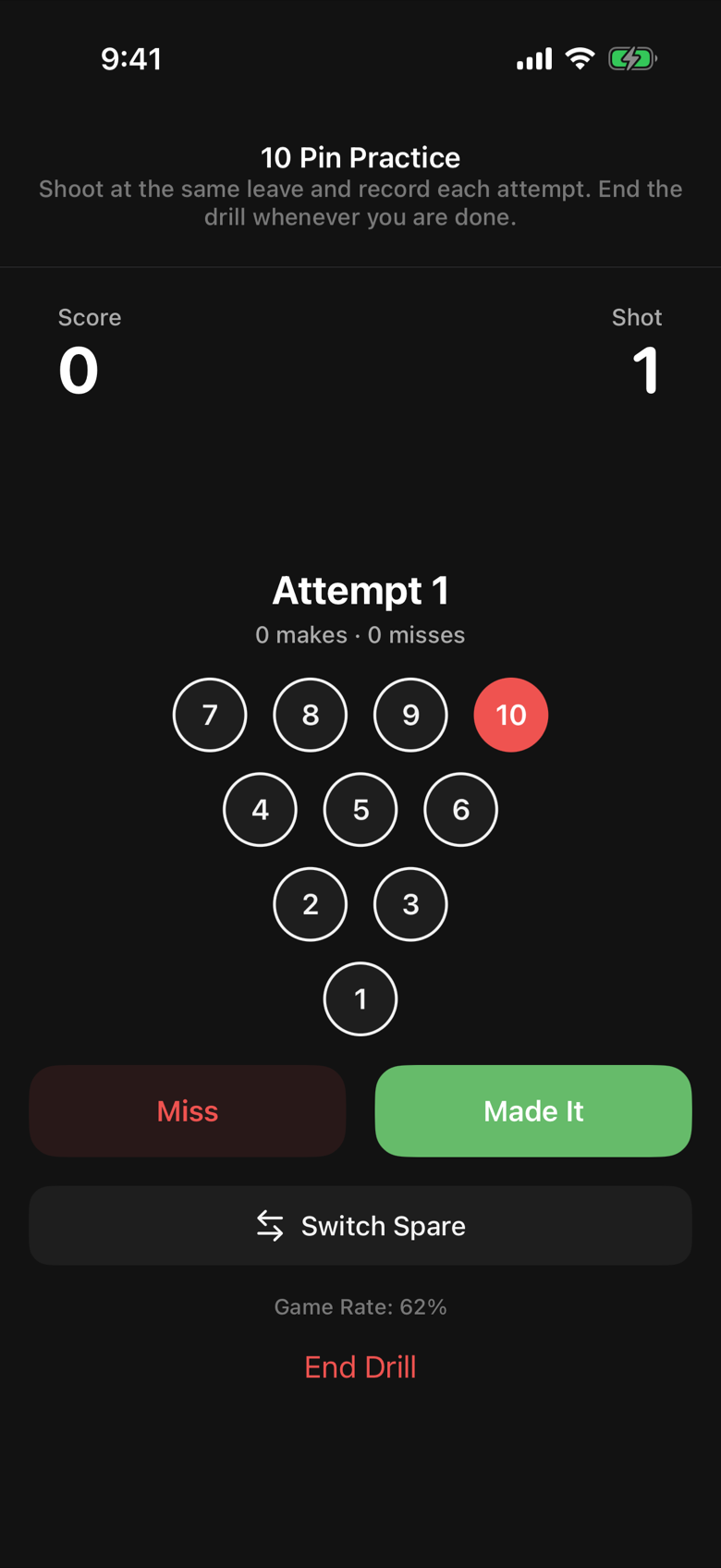
Spare Practice. Pick one leave and shoot at it for twenty shots, counting makes. The app has this as a drill: New Session, then Drills, then Spare Practice, with presets for single pins, common splits and multi pin leaves, or tap the pins you want. It shows your current rate for that leave and tracks the drill.
Low Ball. Try to score as low as you can in twenty shots without gutters (gutters count ten). It's a great way to work on corner pin conversion accuracy.
Progression and Pyramid. Make each spare five times before moving on; miss and start that pin over. Long, humbling, effective.
Random Pin. Every single pin, one after another, twenty shots. One point per make.
All four are built into the app as Drills. The free tier includes one drill session a month; Pro users can track unlimited drills.
Consistency is key
With bowling, you are trying to repeat your actions as consistently as possible. One way to do that is to be mindful and watch where you stand, aim and where your ball goes.
Within the app, you can use targeting reminders to help. You can set and adjust targets for: breakpoint, arrow target, sliding board and starting board. Beyond setting targets, it's important to watch with intention on how your ball goes down the lane. Are you hitting targets? If not, are you missing left or right?
The more consistent your targeting, the more control you'll have on the lanes.
Once the first ball is repeatable, the spare systems give the second ball the same treatment.
Forecasting your gains
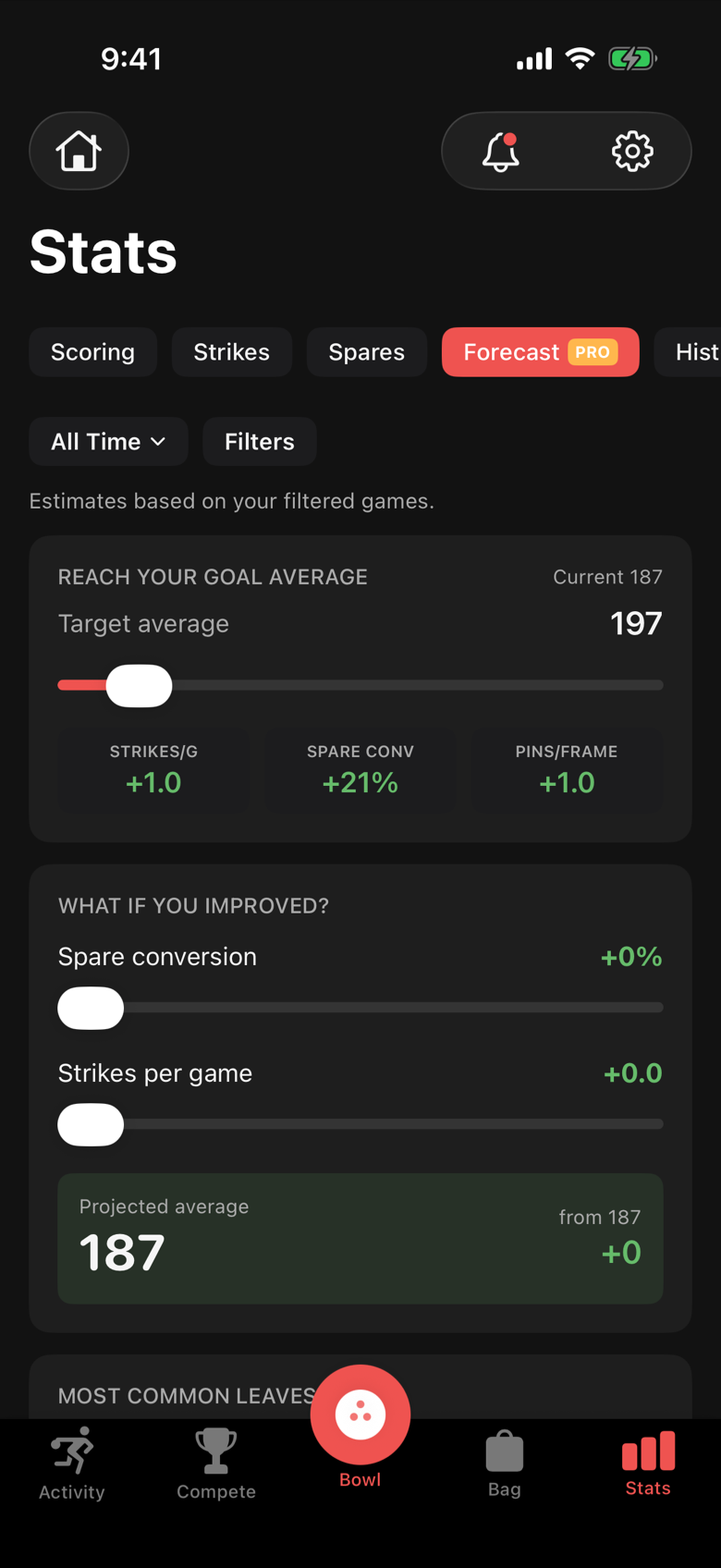
The Forecast tab can help you understand how much different improvements such as improving strike or spare conversion can impact your average, or what you can do to reach a target average.
For most bowlers averaging less than 180, improving spare conversion is likely going to be more impactful than improving strike rate. But everyone's game is different, and your forecasting is customized to your stats and game.
FAQ
Should I work on strikes or spares first?
For most bowlers, it's best to work on spare conversion. Strikes for show, spares for dough!
Does a new ball raise your average?
Maybe, maybe not. New balls perform their best out of the box, so your new ball is likely to perform well out of the box. But having a large selection of balls can also make it hard to decide which ball to use in which situation. It's often better to focus on improving your game rather than buying more balls.
What is a good average?
A common house league average is anywhere from 140 to 170. A 180 would put you in the top third of most casual leagues. A 200 average is a great achievement, and a 220 average would be equivalent to being a scratch golfer. Expect to lose twenty to thirty pins if you move from a house shot to a sport shot.