How to build your bowling ball arsenal
Your arsenal is your collection of bowling balls. Typically, most league bowlers have at least a strike ball and a spare ball, but many bowlers will bring up to 6 balls to league and have many more at home. This guide covers what the three should be, what the numbers on the box mean, and how to find out which of your balls is really earning its spot.
What type of bowler are you?
Before buying anything, it's good (but by no means required) to know two things: your ball speed and your rev rate (the rev rate guide shows how to measure it with your phone). Together they can help decide what balls and what layouts might be best for you.
A high rev, lower speed bowler is going to generate plenty of hook, so a strong ball may hook too early and be harder to control on a house shot. A lower rev, higher speed bowler has the opposite issue and may better match up with a stronger ball with more surface.
Most bowlers are somewhere in the middle. And benchmark balls are designed to work for most bowlers.
Your three ball arsenal
- A benchmark ball. Medium strength, solid or hybrid reactive cover, a symmetrical or mildly asymmetrical core, factory finish somewhere in the 2000 to 3000 grit range. This is the ball you throw first on a fresh house shot to see what the lane is doing. It should be predictable before it is powerful.
- A plastic or urethane ball for spares. You'll use this ball for any spares you want to throw straighter at.
- Depending on where you bowl, you might want a stronger ball for heavy oil which will tend to have a dull cover and a strong core. You also might prefer a weaker ball for game 2 and 3 when the lanes have transitioned and are hooking more. These often have a shinier surface and a weaker core.
What bowling ball specs mean
Bowling ball specifications can seem confusing at first. Here's a simplified explanation:
Coverstock is the shell. This is the biggest factor in a ball's behavior. Plastic barely hooks. Urethane hooks early and smoothly. Reactive resin hooks the most, and comes in solid (earliest, smoothest), pearl (later, sharper) and hybrid (in between) varieties.
RG (radius of gyration) describes how the weight is distributed in the core. A lower RG, around 2.47 to 2.50, revs up sooner and hooks earlier. A higher RG, 2.53 and up, saves its energy for the back of the lane.
Differential is the difference in RG between two axes of the core. Higher differential means more flare, which means the ball keeps finding fresh surface as it rolls and hooks more overall. You'll notice this with the oil tracks on the ball when it comes back from the ball return. More and wider oil tracks is the sign of more flare.
Low differential balls (under 0.030) tend to be straighter and smoother while high differential balls (0.050 and up) tend to hook more.
Layout is how the pro shop drills the ball relative to your positive axis point. A layout can make the same ball roll earlier or later.
Core is the weight block inside the ball. A symmetrical core rolls smoothly and predictably, which is what most benchmark and spare balls use. An asymmetrical core has a stronger, more angular motion at the back end and tends to be more sensitive to layout. If you're building your first arsenal, symmetrical cores are the easier place to start.
You do not have to memorize any of this. If you can just tell your pro shop something like: "I average 165, I throw about 15 mph with around 300 RPM, I want a benchmark ball" they should be able to take care of you.
Learn how to change the surface
The easiest way to change your arsenal is to adjust the surface on a ball. Taking a polished or shiny ball to 1000 grit with a sanding pad will make it hook earlier and smoother. Polishing or sanding a dull ball at a higher grit like 4000 will make it go longer down the lane. Your pro shop can usually do this for you using a ball spinner, or you can get sanding discs and do it yourself.
Generally, you want to work your way from a lower grit to your target surface grit. So for example, if you want to take a ball to 1500 grit you could start with 500 grit, then 1000 grit, and finally 1500 grit.
If your benchmark ball feels like it stopped hooking, try to change surface before buying a new ball. If it hooks too early, try polish.
Maintain your arsenal
Aside from surface adjustments, it's important to maintain your arsenal to ensure good performance. Reactive balls absorb oil with every throw. Invest in a good shammy and wipe your ball before each throw. Depending on how frequently you bowl, it's also good to use surface cleaner periodically. Some bowlers clean before or right after each league night. At the very least, monthly cleanings with any reputable cleaner, wipes or even rubbing alcohol will help maintain your performance.
Track every ball in your arsenal
There's always an element of chance when buying a new ball. Not every ball works well for every bowler. It's rare for a ball to stay in print for years, but if it does that's a good indicator that it is likely useful for most bowlers. Balls like this include the Storm Phaze II or Motiv Venom Shock. Understanding where a ball will fit in your arsenal will increase your odds that your new ball is a good addition.
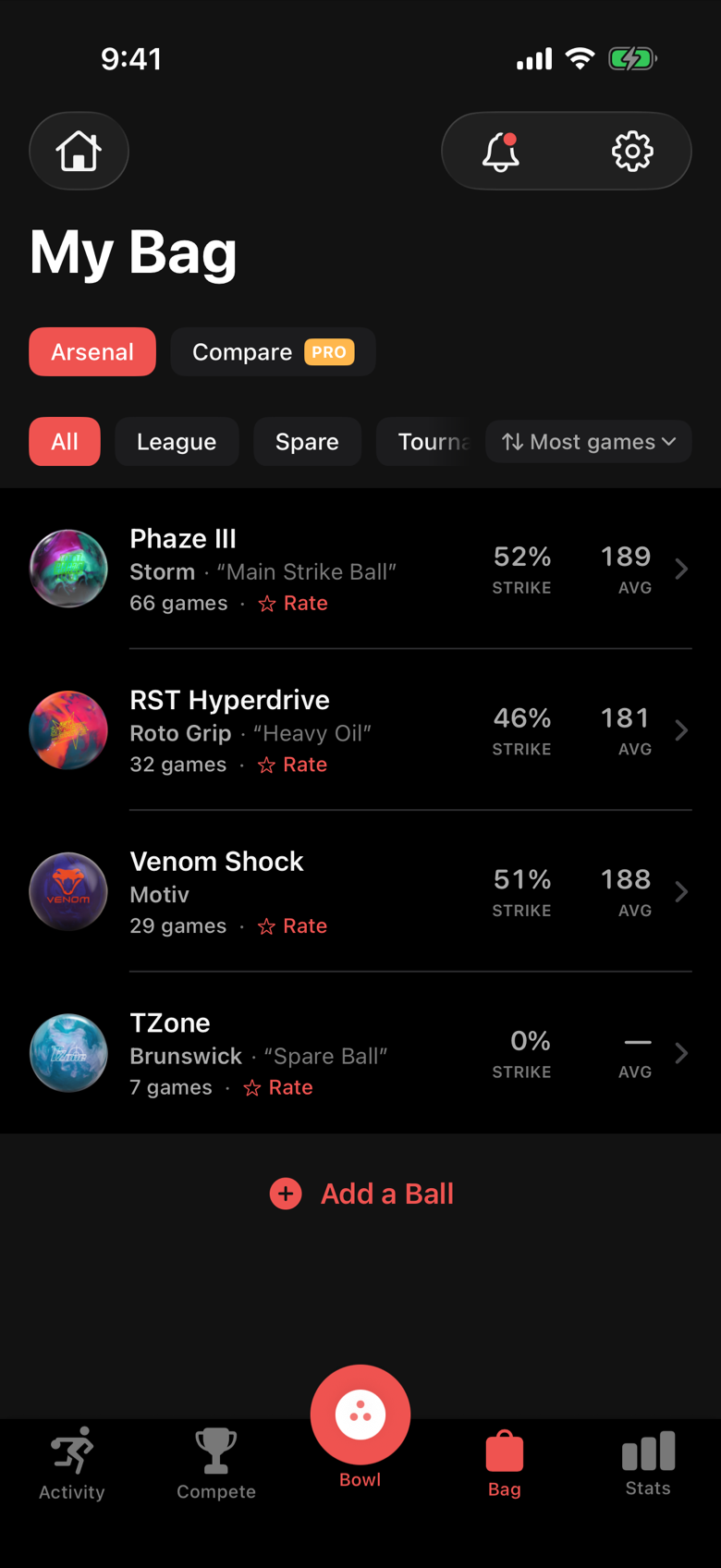
Add a ball from the catalog (New, Popular and Top Rated sections, or search) and Advanced Bowling Tracker fills in key details like coverstock, core, RG, differential and factory finish. If a ball is missing, the "Can't find your ball?" link opens a short form and it goes into the catalog for everyone. You can also keep a wishlist alongside the bag.
Then just start bowling and tracking your shots with each ball. Every game you record with a ball selected adds to that ball's record. Switch balls mid game with the ball pill under the pin deck, so the stats follow the ball, not the game.
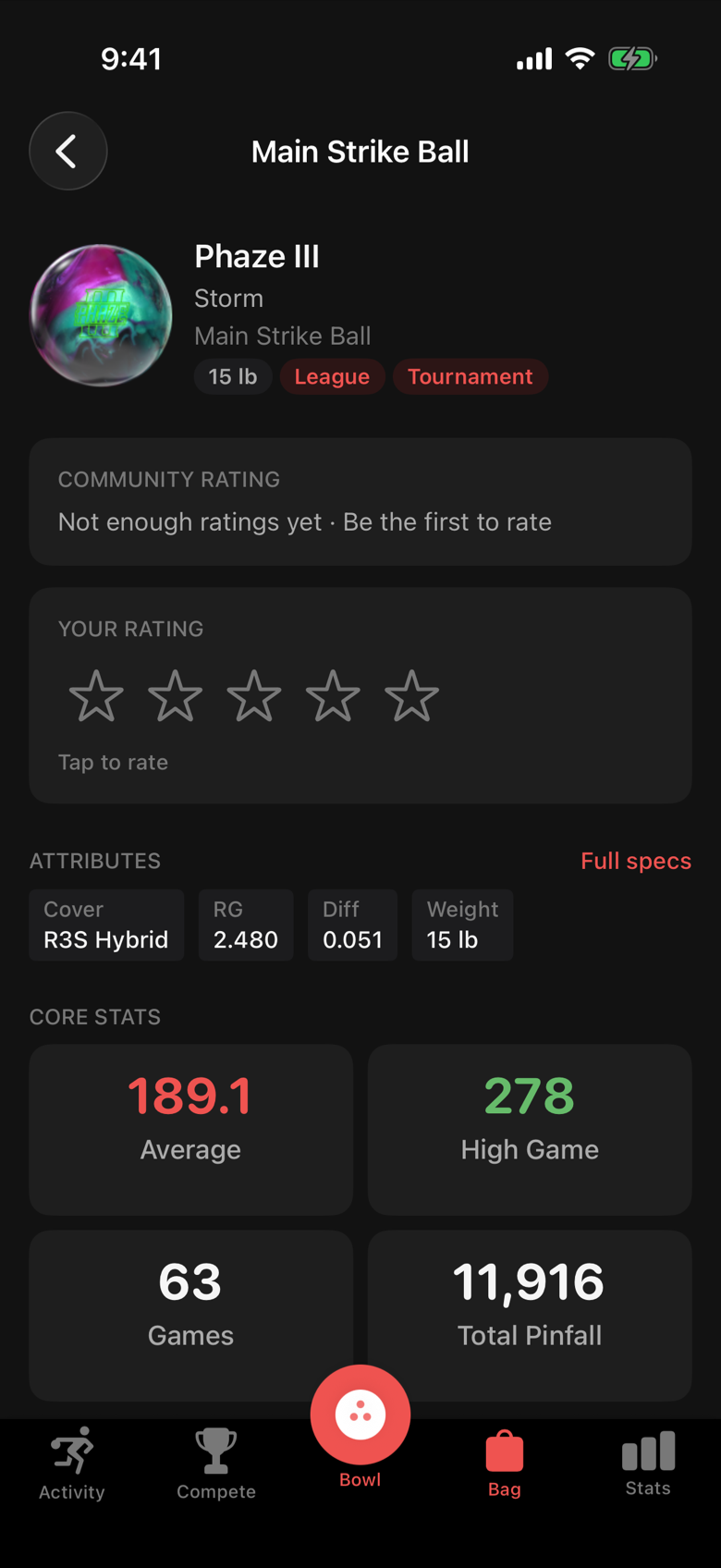
Each ball's page shows its attributes, your layout, and your numbers: average, high game, games, total pinfall, strike percentage, spare conversion, single pin leave rate and split rate, recent trends, and a breakdown by session type.
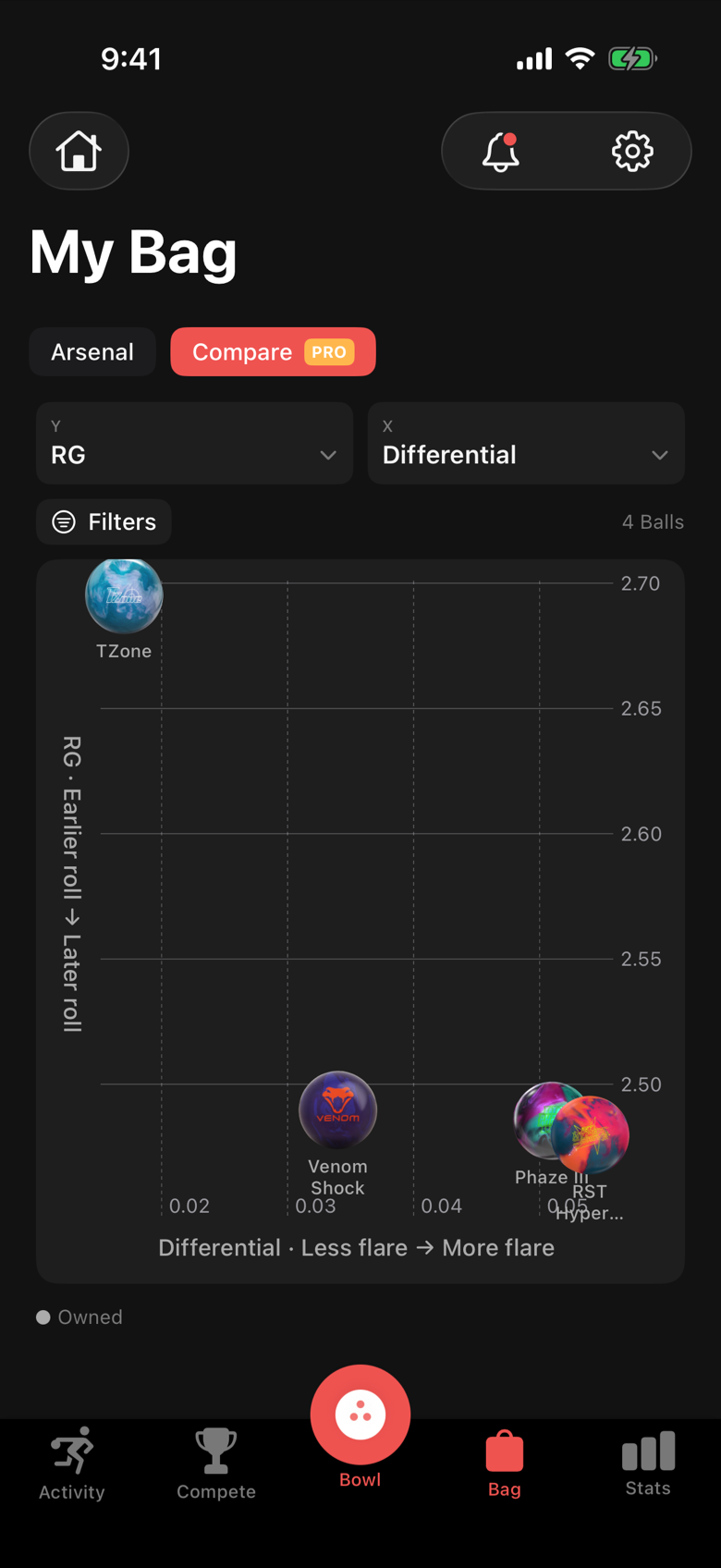
Use the Compare tool to visualize your arsenal on one chart. Pick the axes, RG, differential, strike percentage, game average or first ball average. A ball with two hundred games on it and the worst average in your bag might be one to retire.
The app also has an oil pattern library (Kegel, PBA and USBC patterns) and records the pattern per session, so over time you can see which ball you scored with on which pattern.
Rating and community
Rate your balls one to five stars in the app and compare with community ratings once enough bowlers have rated the same ball. Ratings can be another good signal of which balls tend to work for most bowlers.
FAQ
How many bowling balls do I need?
For most league bowlers, start with a strike ball and a spare ball. Your first strike ball should likely be a benchmark ball.
When should I replace a ball?
Bowling balls can last for years with proper maintenance. But if you notice a ball losing its power even after periodic cleaning and detoxing, it's probably time to replace the ball.
Does the app recommend balls for me?
Not yet, but as the number of users grows we may be able to determine ball recommendations that may suit you based on similar bowlers.
Is a spare ball worth it?
Absolutely! Consider a spare ball as your second ball. Read more in our 10 pin guide.
What weight should I throw?
For most adult bowlers, a properly fit ball at 14 or 15 pounds is your best bet.